









July 22, 2010 | permalink
(Originally published on FastCompany.com.)
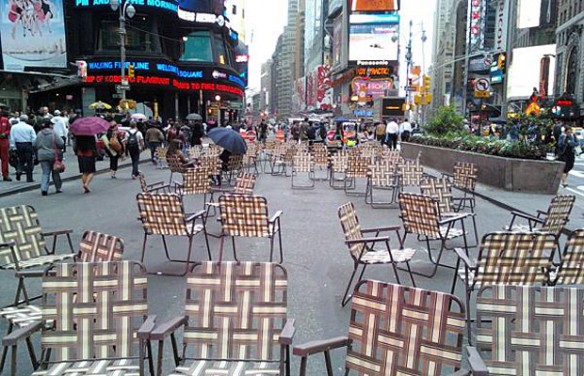
“New York? The whole damn place has been turned into a suburb,” sneered David Harvey, startling a roomful of New Yorkers who prided themselves on the same things he derided: the makeover of the city’s parks; the new network of bike lanes; the pedestrian malls along Broadway. “The feel of the city is losing its urbanity and being made okay for suburbanites to enjoy Times Square,” he continued, going on to condemn New York’s gentrification not on aesthetic or nostalgic grounds, but for being at the root of the financial crisis.
Harvey is having a bit of a moment in America, as much as any neo-Marxist economic geographer can. Earlier this month, his lucid explanation of the “econopocalyspe” (accompanied by animated whiteboard doodles) was a modest hit on Boing Boing. Richard Florida borrowed his concept of the “spatial fix”—the idea that capitalism gets bigger and badder every time it’s wriggles out of a crisis—for his latest book, The Great Reset. And Harvey’s own book-length explanation of the crisis, The Enigma of Capital is set to be published on these shores in September.
On Tuesday night in Manhattan, Harvey made a rare American appearance to discuss “experimental geography” and the role cities and suburbia played in the crisis. Starting from the idea of a “geographic unconscious”—“the way we think of space and time as ‘natural’ when they’re really constructed,”—Harvey blamed suburbia for brainwashing Americans into being good capitalists.
But the connections between urbanism and capitalism go deeper than that. In an essay published in New Left Review, he drew connections between Haussmann’s Paris, postwar America, gentrification and China’s instant cities. In each case, the construction efforts employed huge quantities of labor and required new forms of capital and credit, whether FHA mortgages or CDOs. In his estimation, China’s breakneck urbanization and the appetite for raw materials this creates is the only thing propping global capitalism up.
At the same time, gentrification has become just another name for suburbia. “Shopping malls, multiplexes and box stores proliferate,” he wrote, “as do fast-food and artisanal market-places. We now have, as urban sociologist Sharon Zukin puts it, ‘pacification by cappuccino’. Even the incoherent, bland and monotonous suburban tract development that continues to dominate in many areas now gets its antidote in a ‘new urbanism’ movement that touts the sale of community and boutique lifestyles to fulfill urban dreams.”
And New York is the biggest offender of them all. “The billionaire mayor, Michael Bloomberg, is reshaping the city along lines favourable to developers, Wall Street and transnational capitalist-class elements, and promoting the city as an optimal location for high-value businesses and a fantastic destination for tourists. He is, in effect, turning Manhattan into one vast gated community for the rich.” Harvey is merely putting into Marxist terms the same laments offered recently by Patti Smith (“New York has closed itself off to the young and the struggling… So my advice is: Find a new city”) and the anonymous blogger behind Lost City, who viciously described Bloomberg’s city as “homogenous, anodyne, whitewashed, suburban, toothless, chain-store-ridden, ordinary, exclusive and terribly, terribly expensive. A town for tourists and the upper 2%.”
Cities like New York “are increasing being constructed around spectacle,” Harvey argued Tuesday night. “One aspect of capital is that it wants to move faster and faster; capital cannot abide a long period without change.” In cities like Beijing, Shanghai and Mumbai, this change is being brought about by land grabs and slum clearance. In New York and other financial capitals, it’s gentrification “making cities a spectacle that is instantly consumed.” In other words, we’re blinded by the lights to our Matrix-like existence. “We’re all suburbanites now, without knowing it,” he said. “We’re all neoliberals now, without knowing it.”
In its place, Harvey has called for a “right to the city” to be recognized as a human right. Considering the urban tsunami that’s coming—3 billion additional city-dwellers on top of 3.3 billion now—he has a point. The future of humanity is an urban future, and at this moment America is staring at millions of home foreclosures while China is bulldozing neighborhoods as it sees fit.
Like any committed socialist, Harvey ended his brief talk with a call to arms (a theorist’s call to arms, but still): “We’ve got to revolutionize the geographic subconscious; we’ve got to revolutionize daily life—that’s what really matters. In changing the city, we change ourselves. The real question is: what kind of people do we want to be?”
[Image via flickr/CarlMiKoy]

» Folllow me on Twitter.
» Email me.
» See upcoming events.
Greg Lindsay is a generalist, urbanist, futurist, and speaker. He is a non-resident senior fellow of the Arizona State University Threatcasting Lab, a non-resident senior fellow of MIT’s Future Urban Collectives Lab, and a non-resident senior fellow of the Atlantic Council’s Scowcroft Strategy Initiative. He was the founding chief communications officer of Climate Alpha and remains a senior advisor. Previously, he was an urban tech fellow at Cornell Tech’s Jacobs Institute, where he explored the implications of AI and augmented reality at urban scale.

January 31, 2024
Unfrozen: Domo Arigatou, “Mike 2.0”
January 22, 2024
The Future of Generative AI in Architecture, Engineering, and Construction
January 18, 2024
The Promise and Perils of the Augmented City
January 13, 2024
Henley & Partners: Generative AI, Human Labor, and Mobility

----- | January 22, 2024
The Future of Generative AI in Architecture, Engineering, and Construction
----- | January 1, 2024
----- | August 3, 2023
CityLab | June 12, 2023
Augmented Reality Is Coming for Cities
CityLab | April 25, 2023
The Line Is Blurring Between Remote Workers and Tourists
CityLab | December 7, 2021
The Dark Side of 15-Minute Grocery Delivery
Fast Company | June 2021
Why the Great Lakes need to be the center of our climate strategy
Fast Company | March 2020
How to design a smart city that’s built on empowerment–not corporate surveillance
URBAN-X | December 2019
CityLab | December 10, 2018
The State of Play: Connected Mobility in San Francisco, Boston, and Detroit
Harvard Business Review | September 24, 2018
Why Companies Are Creating Their Own Coworking Spaces
CityLab | July 2018
The State of Play: Connected Mobility + U.S. Cities
Medium | May 1, 2017
Fast Company | January 19, 2017
The Collaboration Software That’s Rejuvenating The Young Global Leaders Of Davos
The Guardian | January 13, 2017
What If Uber Kills Public Transport Instead of Cars
Backchannel | January 4, 2017
The Office of the Future Is… an Office
New Cities Foundation | October 2016
Now Arriving: A Connected Mobility Roadmap for Public Transport
Inc. | October 2016
Why Every Business Should Start in a Co-Working Space
Popular Mechanics | May 11, 2016
Can the World’s Worst Traffic Problem Be Solved?
The New Republic | January/February 2016