









March 04, 2011 | permalink
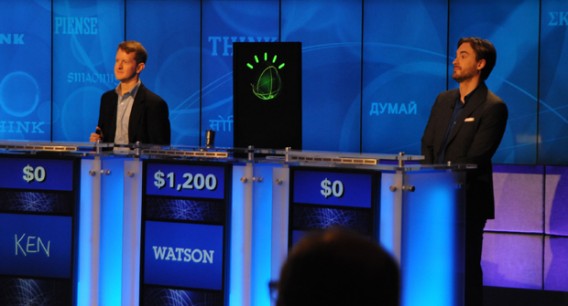
It already feels like a million years ago (have the machines taken over yet?), but it’s been barely twelve months since I schlepped to IBM’s Eero Saarinen-designed research campus in Westchester to spar with Watson, it’s then-secret, now-famous Jeopardy!-playing supercomputer. I thrashed him three times only a week after he’d gone undefeated against his human opponents, and I’ve been dining out on it ever since. If you want to hear the story (and it seems everyone does) I wrote about the experience for both Fast Company and McKinsey Quarterly, noting in each story that Watson had me playing his game in no time, hop-scotching all over the board and racing to find Daily Doubles ahead of him. This was not new. As I noted in the McKinsey Quarterly story:
I was hardly the first person to try and beat a computer at its own game rather than stick to a human one. World chess champion Garry Kasparov, in the third game of his match with IBM’s Deep Blue in May 1997, chose to open with the esoteric Mieses Opening1 in a deliberate attempt to drag the computer out of its well-practiced repertoire of openings. It worked, but required Kasparov to abandon his repertoire as well. The game eventually ended in a draw.
Kasparov lost that match three games later in crushing fashion, leading Newsweek to dub his defeat “The brain’s last stand.” Rather than be embittered by his loss and computing’s subsequent hostile takeover of chess, Kasparov has become a proponent of man–machine collaboration. In “freestyle” tournaments, human–computer teams running the most basic commercial software have managed to crush the best chess programs on the market, which in turn had crushed most grand masters. “Having a computer program available during play was as disturbing as it was exciting,” he wrote in the New York Review of Books.
“The machine doesn’t care about style or patterns or hundreds of years of established theory,” he added. “It is entirely free of prejudice and doctrine, and this has contributed to the development of players who are almost as free of dogma as the machines with which they train. Increasingly, a move isn’t good or bad because it looks that way or because it hasn’t been done that way before. It’s simply good if it works and bad if it doesn’t. Although we still require a strong measure of intuition and logic to play well, humans today are starting to play more like computers.”
Jennings tried similar tactics against Watson, but the machine was simply too fast. You could tell Jennings was ticked, but at least he didn’t cry like Kasparov. As I predicted for Fast Company before the match:
So that’s my strategy, and it worked for me. But Jennings and Rutter will be facing a much tougher opponent—you would think Moore’s Law alone would have made Watson that much tougher by now—and he, in turn, will be battling much better players than I. But I had one other advantage they won’t—I felt no pressure to win, let alone on national television with a $1 million first prize on the line. The computer doesn’t feel it either, and this time around, that gives him the edge.
My money’s on Watson (although just how well he buzzes with his new electro-mechanical “hand” is anyone’s guess). I just hope the humans don’t cry this time. That would be so like us.

» Folllow me on Twitter.
» Email me.
» See upcoming events.

Greg Lindsay is a generalist, urbanist, futurist, and speaker. He is a non-resident senior fellow of the Arizona State University Threatcasting Lab, a non-resident senior fellow of MIT’s Future Urban Collectives Lab, and a non-resident senior fellow of the Atlantic Council’s Scowcroft Strategy Initiative. He was the founding chief communications officer of Climate Alpha and remains a senior advisor. Previously, he was an urban tech fellow at Cornell Tech’s Jacobs Institute, where he explored the implications of AI and augmented reality at urban scale.

January 31, 2024
Unfrozen: Domo Arigatou, “Mike 2.0”
January 22, 2024
The Future of Generative AI in Architecture, Engineering, and Construction
January 18, 2024
The Promise and Perils of the Augmented City
January 13, 2024
Henley & Partners: Generative AI, Human Labor, and Mobility

----- | January 22, 2024
The Future of Generative AI in Architecture, Engineering, and Construction
----- | January 1, 2024
----- | August 3, 2023
CityLab | June 12, 2023
Augmented Reality Is Coming for Cities
CityLab | April 25, 2023
The Line Is Blurring Between Remote Workers and Tourists
CityLab | December 7, 2021
The Dark Side of 15-Minute Grocery Delivery
Fast Company | June 2021
Why the Great Lakes need to be the center of our climate strategy
Fast Company | March 2020
How to design a smart city that’s built on empowerment–not corporate surveillance
URBAN-X | December 2019
CityLab | December 10, 2018
The State of Play: Connected Mobility in San Francisco, Boston, and Detroit
Harvard Business Review | September 24, 2018
Why Companies Are Creating Their Own Coworking Spaces
CityLab | July 2018
The State of Play: Connected Mobility + U.S. Cities
Medium | May 1, 2017
Fast Company | January 19, 2017
The Collaboration Software That’s Rejuvenating The Young Global Leaders Of Davos
The Guardian | January 13, 2017
What If Uber Kills Public Transport Instead of Cars
Backchannel | January 4, 2017
The Office of the Future Is… an Office
New Cities Foundation | October 2016
Now Arriving: A Connected Mobility Roadmap for Public Transport
Inc. | October 2016
Why Every Business Should Start in a Co-Working Space
Popular Mechanics | May 11, 2016
Can the World’s Worst Traffic Problem Be Solved?
The New Republic | January/February 2016