









January 31, 2024 | permalink
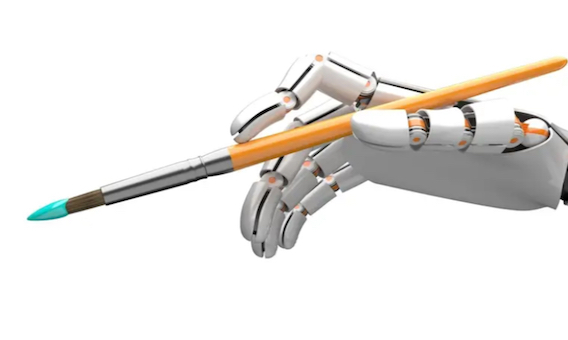
As part of my report for Cornell Tech on the uses (and abuses) of generative AI in architecture, engineering, and construction, my Unfrozen podcast co-host Daniel Safarik and I cornered Thornton Tomasetti CTO Robert Otani to talk about his efforts to create a large language model based on the firm’s retiring metallurgy expert, “Mike.” What does it mean to consult a digital twin of your colleague based on 30 years of email and notes? Listen in to learn more, or check out our year-end recap/new year preview and other episodes at Unfrozen.
January 22, 2024 | permalink
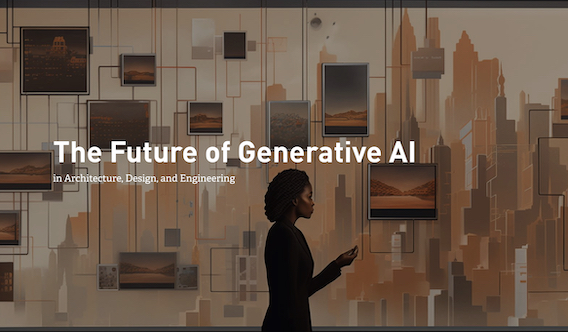
(As part of my urban tech fellowship at Cornell Tech, I co-authored this report for the Jacobs Urban Tech Hub on how the architecture, engineering, and construction industries should approach generative AI. A link to the full report is at bottom.)
The world of digital creation is being redefined by Generative AI (GAI), a groundbreaking class of tools that has captivated both creators and consumers. At the forefront of this revolution are Large Language Models (LLMs) like GPT-4, renowned for their versatility in natural language processing, machine translation, and content creation, including novel works and even software code. Since its introduction, GAI has surged in popularity, with products like ChatGPT setting records in user growth. Similarly, image generators such as OpenAI’s DALL-E and Stability AI’s Stable Diffusion are redefining artistic expression, blurring the lines between AI-generated images and human-created art.
These advancements are built on the deep learning revolution, utilizing immense datasets to teach algorithms complex patterns through unsupervised learning. This has led to foundation models with unprecedented sophistication, sparking significant global interest across various sectors, including politics, culture, and industry. Yet, as GAI’s capabilities expand, so do the concerns and responses from industries and unions like SAG-AFTRA and WGA, emphasizing the need for thoughtful integration and ethical considerations in GAI deployment.
In the realm of architecture, engineering, and construction (AEC), GAI presents both transformative opportunities and complex challenges. Prompted by this, the Innovation Design Consortium (IDC) teamed up with the Jacobs Urban Tech Hub to explore GAI’s future implications. Our report, written by urban tech fellow Greg Lindsay and urbanist-in-residence Anthony Townsend, offers an overview of GAI’s potential impact on the AEC industry. Featuring interviews with:

DOWNLOAD THE FULL REPORT HERE
January 18, 2024 | permalink

The Thompson Reuters Foundation’s Carey Baron has published a dispatch on the promise and perils of augmented reality ahead of the impending launch of the Apple Vision Pro and rollout of Meta’s Ray-Ban Wayfarers equipped with cameras, microphones, and onboard AI. He was kind enough to quote raising the alarm that cities need to get ready for what’s coming:
But experts warn that authorities are not prepared for the challenges that will come when residents themselves increasingly harness the power of AR. They say this blending of digital and physical spaces will raise legal and ethical questions - around privacy rights and data protection, for example - that have not yet been sufficiently considered.
“Cities are not really prepared for this,” said Greg Lindsay, an urban tech fellow at Cornell Tech’s Jacobs Institute in New York. “How do you prepare to regulate technologies that don’t exist or are still nascent?”
Read more about inCitu’s work with cities in visualizing future development and ever-fascinating legacy of Pokémon Go. And watch this space for my forthcoming final report!
January 13, 2024 | permalink

(Henley & Partners — the consultancy that more or less invented citizenship-by-investment — invited me to contribute a short essay on the immediate- and downstream effects of AI on global labor and mobility for their most recent Global Mobility Report.)
“Technology is the answer…but what was the question?” asked the British architect Cedric Price in 1966, back when IBM mainframes were the state of the art in computation. Fast forward to 2024, when artificial intelligence (AI) — particularly large language models (LLMs) headlined by OpenAI’s Generative Pre-trained Transformer 4 (GPT-4) model — has taken corporate boardrooms by storm, offering answers to the future of nearly everything while eliding questions as to its true potential. Is the current wave of hype a mere flash-in-the-pan, a step-change disruption, or a transformational shift in computing?
The questions AI poses for global mobility professionals and policymakers are similar. Are there painful bottlenecks in relocation and migration that generative AI is uniquely positioned to solve, or is it a solution in search of problems to justify its adoption? If the former, will newfound gains in simplicity and efficiency persist, or will institutions respond in kind with technologically aided obstacles and complexity? Because AI doesn’t exist in a political vacuum. While mobility professionals may rejoice at AI’s ability to reduce friction for desirable workers and economic migrants, it might well be deployed to harden borders and suppress the need for migrants altogether. The questions AI ultimately answers may not necessarily be the ones we hoped to ask.
How AI Works
Before speculating on generative AI’s potential uses (and abuses), it’s important to understand how it works — and hence its strengths and weaknesses. Simply put, LLMs such as ChatGPT, Google’s Bard, and Anthropic’s Claude combine vast amounts of data with transformers (the ‘T’ in ChatGPT) trained to weigh inputs and generate output ranging from code to cats and everything in between. The probabilistic nature of transformers is also responsible for LLMs’ inherent ‘hallucination’ problems and led skeptics to dismiss generative AI as autocomplete on steroids, which is both true and beside the point.
Contrast the doubters’ dismissiveness with Bill Gates, who has described ChatGPT as one of “two demonstrations of technology that struck me as revolutionary,” the other being the graphical user interface (GUI) underpinning Windows. The comparison is instructive — if the GUI replaced the command line with drop-down menus, AI promises to do away with the desktop or search bar altogether. Rather than users tapping, swiping, or pointing-and-clicking, AI-powered agents will do the hard work of finding, analyzing, and bringing information to them. One example is Paidleave.ai, a free tool assisting residents of New York in discovering, applying for, and receiving eligible state benefits.
Boosting system efficiency with AI
In a similar vein, I recently led a team of researchers at Cornell Tech’s Jacobs Urban Tech Hub tasked with creating an AI “nutrition label” that evaluates leading tools according to the needs of the architecture, engineering, and construction industries. Using GPT-4 embedded within Microsoft Bing, we asked the AI to grade itself and its competitors using our criteria. Not only did it award dozens of grades without human intervention, it also supplied 170,000 words worth of reasoning, links, and citations justifying its decisions. It would be easy to dwell on the dozens — if not hundreds — of hours we would have otherwise spent compiling such a dossier, but more important was how it empowered us to focus on what questions we wanted to ask, rather than how we would answer them.
Seen this way, generative AI’s potential for global mobility professionals such as investment migration experts is profound. Instead of performing repetitive tasks such as filling forms or battling through screens running on antiquated systems, increasingly sophisticated agents could handle these tasks, freeing professionals to think more creatively about their roles and what they can offer, such as:
• Asking AIs to read, parse, and analyze government websites to stay abreast of migration policy changes
• Personalized recommendations and options for relocating employees, sourced and assembled by AI agents
• Real-time translation services combined with a new generation of wearable devices, such as the Ray-Ban Meta Wayfarers, which enable wearers to vocally ask onboard AI what they are hearing or seeing
And so on. With two big caveats (or at least two). The first being upon closer inspection of GPT-4’s scores for our nutrition label, we sometimes found its judgement to be faulty, albeit logically consistent, underscoring the pitfalls of relying on all-purpose LLMs trained by scraping large swaths of the open web. Our exercise highlighted the need for mobility professionals to carefully conserve, secure, and harness data that is specific to the industry and individual firms for refining and fine-tuning AI models to reduce the number of errors and hallucinations.
Second, just because AI can be employed to streamline and simplify bureaucratic complexity doesn’t mean it can’t (or won’t) be used to manufacture it too. One of the domains where generative AI is already being put productively to work, for instance, is answering requests for proposals. IBM, Twilio, and other companies are building commercial tools that employ similar methods to our little hack at Cornell Tech. One such start-up recently received a request for proposal that its CEO suspected had been generated by ChatGPT. “And guess what?” he told Wired. “We responded with our own AI.” Governments accustomed to relying on bureaucratic moats may well choose to fight AI fire-with-fire.
Human labor and ‘remote intelligence’
Beyond these immediate applications, there are second-order effects of AI and automation poised to transform labor mobility for the worse, particularly for less-skilled workers comprising the majority of migrants. Across the Global North, the governments of Britain, Germany, and Italy — along with a possible second Trump administration — are caught in the bind of being implacably opposed to migrants while simultaneously dependent on them. In this context, if AI is the technological answer, the question may be, “How do we eliminate the need for migrants altogether?”
In 2019, the economist Richard Baldwin — inspired by a previous wave of advances in machine learning — predicted a “globotics upheaval” driven by a combination of growing automation and what he labeled “remote intelligence”, a new phase of outsourcing and offshoring enabled by advances in software and bandwidth. Five years and a pandemic later, evidence for this upheaval is already apparent. Autonomous delivery start-ups such as Serve, Coco, and Kiwibot typically use remote tele-operators to guide their robots through difficult situations. In Kiwibot’s case, deliverybots making their rounds on American university campuses are being driven by workers stationed in Bogotá, Colombia.
Another example is OryLab’s Avatar Robot Café DAWN ver.ß in Tokyo, where the robotic staff is operated remotely by Japanese residents who are living with disabilities or ill and unable to easily participate in society. While pitched as a public good, it’s not difficult to imagine such a system as an opportunity to displace in-person workers. In fact, a recent survey by Baldwin of nearly 10,000 Japanese workers suggests remote intelligence and AI are complements that are fueling each other’s adoption.
The sovereign power to regulate and the ‘right to compute’
The dystopian end point of this trend may be best depicted by the 2008 sci-fi film Sleep Dealer, which imagines a future of permanently closed borders and would-be migrants outfitted with virtual reality and cybernetics to remotely operate factories and everything else. Technology was indeed the answer; it’s just that the question itself is bone-chilling.
The film highlights how AI is just as likely to reinforce sovereignty as it is to disrupt it. The US’ White House and the European Union have wasted relatively little time in attempting to regulate AI, the former through a comprehensive executive order and the latter through the Artificial Intelligence Act, which restricts “unacceptable” and “high-risk” applications.
These regulations have led to calls from some quarters for an internationally recognized “right to compute” as a subset of free speech. A mysterious start-up named Del Complex has already promised to build AI compute clusters in international waters for clients vehemently opposed to regulation. Meanwhile, the UAE has developed an open source sovereign LLM dubbed “Falcon” a top national priority, and is positioning itself as an enclave of open-mindedness compared to the US, the European Union, and China. “Watch as people migrate to where their digital rights are respected,” warns Stephen Cobb, an AI ethicist at the Dubai-based start-up Haltia.AI. It is only a matter of time before the ‘right to compute’ (or at least the privilege) is folded into nations’ migration policies or even their investment migration programs.
In that case, technology is once again the answer, only this time the question is how the AI arms race will factor into nations’ plans to corner the global market on talent and investment.
December 24, 2023 | permalink

Happy holidays to you and yours! With 2023 nearly in the books, I’m already looking to the year ahead, starting with my inaugural visit to SXSW to moderate a session on “Using Augmented Reality to Drive Inclusive City Development,” starring inCitu CEO Dana Chermesh, former Washington D.C. Department of Buildings chief Ernest Chrappah, and former Denver chief design officer Eugenia Di Girolamo.
If you plan to be in Austin March 9-10, Team inCitu and I are organizing an informal gathering of XR and Government track participants to discuss the public policy ramifications of AI + AR at urban scale. I hope to see you there — or elsewhere, as my 2024 speaking schedule is already shaping up. Here’s to a happy new year!
December 01, 2023 | permalink
Booz Allen Hamilton has posted the full video (and transcript) from “The Age of Principled AI” event and discussion in Washington D.C. on November 6th I had the pleasure of moderating on behalf of Fast Company. Click above to watch.
November 28, 2023 | permalink

Fast Company reviews Renewing the Dream: The Mobility Revolution and the Future of Los Angeles — the new book edited by my friend James Sanders and published by Rizzoli — and is kind enough to quote me amongst a murderer’s row of contributors:
Today, LA is still choked with vehicles, but according to Ducharme from Woods Bagot, it is also teeming with potential. Because LA County isn’t just about cars. It’s also “the epicenter of a mobility revolution that is making, unmaking, and remaking the way we all live and move,” as author Greg Lindsay puts it in an essay featured in the book.
Meanwhile, New York Magazine’s architecture critic Justin Davidson has published his own 2,000-word glowing review over at Curbed, where he captures the book’s central theme succinctly:
Glossily illustrated, lucidly written, and thoroughly reported, the book makes an argument that is simple yet — pardon the expression — seismic: Many drivers would happily ride a bike, grab a scooter, even ride a bus, if only those choices were safe, quick, and convenient. Unfortunately, Americans find themselves in an existential traffic jam, locked in their cars, unable to ditch them and walk.
Davidson goes on to namecheck several projects I’ve had the pleasure of working on with James, including 2018’s “More LA” — imagining how the city might look if its surface parking lots are redeveloped — and “From Pump to Plug,” our submission to a competition to redesign Southern California’s gas station sites. Read the whole — or better yet, buy the book! — for more.

November 14, 2023 | permalink

As the holiday slowdown approaches, so does my travel for speaking…barely. After an uncharacteristically quiet spring, I’ve been back on the road this fall at full throttle, melding my latest dispatches on the future of cities with new talks on generative AI, The Metaverse Metropolis, climate change, and more. As the first snow of the season descends on Montréal (where I’m living full-time again following the conclusion of my Cornell Tech fellowship) here’s a quick recap of where I’ve been and a preview of where I’m headed in the waning weeks of 2023:
• The season began in September with a lunch keynote at URMIA — the largest annual gathering of university chief risk officers — to discuss why they shouldn’t throw the renewables baby out with the bathwater when it comes to electric bikes and solar panels (both of which have a worrying tendency to catch fire). From there it was off to Vegas to headline the opening session at BICSI — one of the largest associations of IT professionals — on the promise and perils of AI (highlights from the conference are below). AI was also the theme of my talk to SIOR’s Philadelphia chapter the following week at SteelStacks in Bethlehem, PA , but I made jaunts in between to speak in Washington to ICSC’s Mid-Atlantic chapter on the future of urban retail, followed by a quick visit to Quebec City to help Convention Centres of Canada imagine how their assets can play a role in post-pandemic urban revitalization.
• As October rolled around, I found myself back in NYC for WRLDCTY, joining my friend and colleague Lev Kushner onstage to speak about the post-pandemic “bleisure” travel and how cities need to combine their tourism and economic development strategies to win the war for talent. (Watch us here!) I then spent consecutive Thursdays in Dallas for Realty Resources, Manhattan for a panel on AI at the architecture firm HOK, and Istanbul for GYODER (pictured below), the largest real estate conference in Turkey.

• November began with an overnight jaunt to Dubai for the Dubai Business Forum, followed immediately by a quick trip to Washington for Booz Allen Hamilton’s ”Age of Principled AI.” Next up is an after-dinner talk for Fiera Capital here in Montréal at the end of the month, followed by my last trips of the year: Kokosing Construction in Columbus, OH; the Southern California Association of Governments 14th Annual Economic Summit in LA (pictured below); and the National Association of College & University Food Services in Kansas City.
And from there, we’ll see where 2024 will take me! Please get in touch if you’d like to add me to your itinerary and vice versa.

November 13, 2023 | permalink
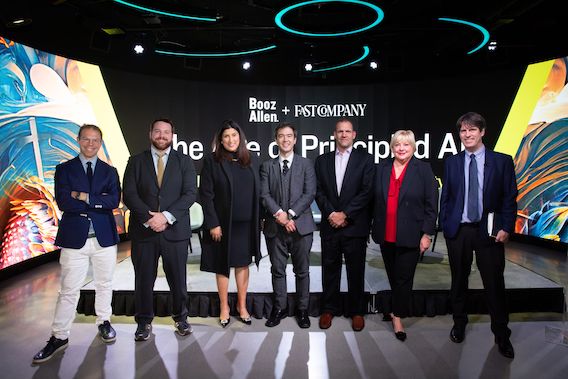
Everything is coming up AI these days, including me. Last week, I had the privilege of moderating “The Age of Principled AI,” a panel hosted by Fast Company and Booz Allen Hamilton exploring the ramifications of President Biden’s Executive Order and how to regulate AI going forward.
I was joined onstage by Navrina Singh, CEO of Credo AI; John Beezer, senior advisor to the U.S. Senate Committee on Commerce, Science, and Transportation; the Department of Defense’s Dr. Matt Johnson; and Randal Meyer, chief counsel and legislative director to Representative Nancy Mace. According to GPT-4’s summary of the event, here’s what we talked about:
1. Turning Point for AI Ubiquity: Susan Penfield, Booz Allen’s CTO, opened the event, highlighting the White House’s executive order on AI and the growing ubiquity of AI in various sectors. She raised critical questions about AI governance and mitigating unintended consequences.
2. Government’s Role in AI: The panelists agreed on the need for a robust regulatory framework for AI. The discussion centered around the recent executive order, highlighting the need for a coherent national policy and its impact on various sectors, including national security.
3. AI in Legislation and Policy: Discussions involved congressional perspectives on AI regulation, touching on the need for statutory authority for AI governance. The panelists debated approaches to AI legislation, including self-certification, third-party audits, and the necessity of establishing clear standards for audits and assessments.
4. Operationalizing AI Ethics: Matthew Johnson, Senior Technical Advisor in Responsible AI at the DoD, discussed the DoD’s approach to operationalizing AI ethics, including a toolkit for responsible AI deployment. This toolkit aims to provide a framework for aligning AI applications with ethical principles and values.
5. Impact of AI on National Security: The panel addressed the implications of AI in national security, including the importance of using AI responsibly and ethically in defense contexts. They emphasized the need for AI technologies that align with democratic values and principles.
6. Role of Procurement in AI Deployment: Discussions highlighted the role of procurement as a tool for influencing the development and deployment of AI technologies. The need for clear criteria and benchmarks to ensure alignment with ethical principles was emphasized.
7. Innovative AI Use Cases in Government: Examples of AI applications in government agencies, such as the Social Security Administration, were discussed to illustrate the potential of AI in improving services and decision-making processes.
8. Need for AI Literacy and Expertise: The panelists underscored the importance of AI literacy and the need to build capacity within government agencies and other stakeholders to understand and effectively use AI.
9. Challenges in AI Regulation: The challenges of regulating AI were a central theme, with discussions around balancing innovation with regulation, anticipating threats, and ensuring that AI applications do not infringe on rights or freedoms.
10. Future of AI Governance: The event concluded with reflections on the necessity of a multi-stakeholder approach to AI governance, the importance of aligning AI with societal values, and the potential of AI to transform government missions and societal outcomes.
November 03, 2023 | permalink

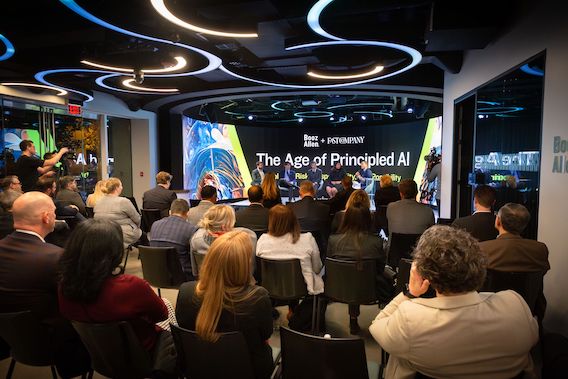
Dubai Chambers invited me to speak at November’s Dubai Business Forum — a networking and dealmaking extravaganza where the (New) New Silk Road was literally being paved. I was fortunate to join the luminaries on stage in the “Future Theatre” — including former Wired editor Chris Anderson and roboticist David Hanson — to speak about strengthening cities’ relationship with nature.
I’ll spare you the details, but I did use this opportunity to ask two generative AI tools (Midjourney and Bing Image Creator) to help me visualize a “desert modern eco district” (as seen below) and a Sheikh Zayed Road without cars (impossible, as it turns out). It was bracing to see the limits of both our own and our tools’ imaginations.


» Folllow me on Twitter.
» Email me.
» See upcoming events.

Greg Lindsay is a generalist, urbanist, futurist, and speaker. He is a non-resident senior fellow of the Arizona State University Threatcasting Lab, a non-resident senior fellow of MIT’s Future Urban Collectives Lab, and a non-resident senior fellow of the Atlantic Council’s Scowcroft Strategy Initiative. He was the founding chief communications officer of Climate Alpha and remains a senior advisor. Previously, he was an urban tech fellow at Cornell Tech’s Jacobs Institute, where he explored the implications of AI and augmented reality at urban scale.

January 31, 2024
Unfrozen: Domo Arigatou, “Mike 2.0”
January 22, 2024
The Future of Generative AI in Architecture, Engineering, and Construction
January 18, 2024
The Promise and Perils of the Augmented City
January 13, 2024
Henley & Partners: Generative AI, Human Labor, and Mobility

----- | January 22, 2024
The Future of Generative AI in Architecture, Engineering, and Construction
----- | January 1, 2024
----- | August 3, 2023
CityLab | June 12, 2023
Augmented Reality Is Coming for Cities
CityLab | April 25, 2023
The Line Is Blurring Between Remote Workers and Tourists
CityLab | December 7, 2021
The Dark Side of 15-Minute Grocery Delivery
Fast Company | June 2021
Why the Great Lakes need to be the center of our climate strategy
Fast Company | March 2020
How to design a smart city that’s built on empowerment–not corporate surveillance
URBAN-X | December 2019
CityLab | December 10, 2018
The State of Play: Connected Mobility in San Francisco, Boston, and Detroit
Harvard Business Review | September 24, 2018
Why Companies Are Creating Their Own Coworking Spaces
CityLab | July 2018
The State of Play: Connected Mobility + U.S. Cities
Medium | May 1, 2017
Fast Company | January 19, 2017
The Collaboration Software That’s Rejuvenating The Young Global Leaders Of Davos
The Guardian | January 13, 2017
What If Uber Kills Public Transport Instead of Cars
Backchannel | January 4, 2017
The Office of the Future Is… an Office
New Cities Foundation | October 2016
Now Arriving: A Connected Mobility Roadmap for Public Transport
Inc. | October 2016
Why Every Business Should Start in a Co-Working Space
Popular Mechanics | May 11, 2016
Can the World’s Worst Traffic Problem Be Solved?
The New Republic | January/February 2016